
TCPA Compliance for Nonprofits: How to Use SMS Effectively Without Breaking Rules
Nonprofits can use SMS effectively without breaking TCPA rules. Learn how TCPA compliance applies to nonprofit text messaging, what consent is required, and how permission-based SMS builds trust, improves deliverability, and drives stronger supporter engagement.


Rather than jumping straight into donation asks, successful nonprofits build SMS programs in layers. Maintaining accurate contact lists, properly managing phone numbers, and verifying consent records are essential for compliance with TCPA regulations.
Under the Telephone Consumer Protection Act (TCPA), text messages are treated similarly to telemarketing calls, meaning nonprofits must follow specific consent, disclosure, and opt-out requirements when using SMS. These rules apply regardless of whether messages are sent via short codes, long codes, toll-free numbers, or automated texting platforms. Understanding how TCPA compliance applies to nonprofit SMS campaigns is essential for reducing legal risk while maintaining effective supporter engagement.
Do nonprofits need consent to send text messages?
Yes. Nonprofits must obtain clear consent before sending fundraising or promotional text messages, typically in the form of prior express written or electronic consent. For informational or transactional messages, implied consent may apply based on prior interactions, but relying solely on implied consent for fundraising texts carries risks. Always provide clear opt-out instructions and respect supporters’ communication preferences to maintain trust and compliance.
But what does that mean in practice? Does TCPA make it impossible for nonprofits to send text messages to supporters?
Not at all. When done correctly, TCPA-compliant SMS actually gives nonprofits several meaningful advantages—both legally and operationally.
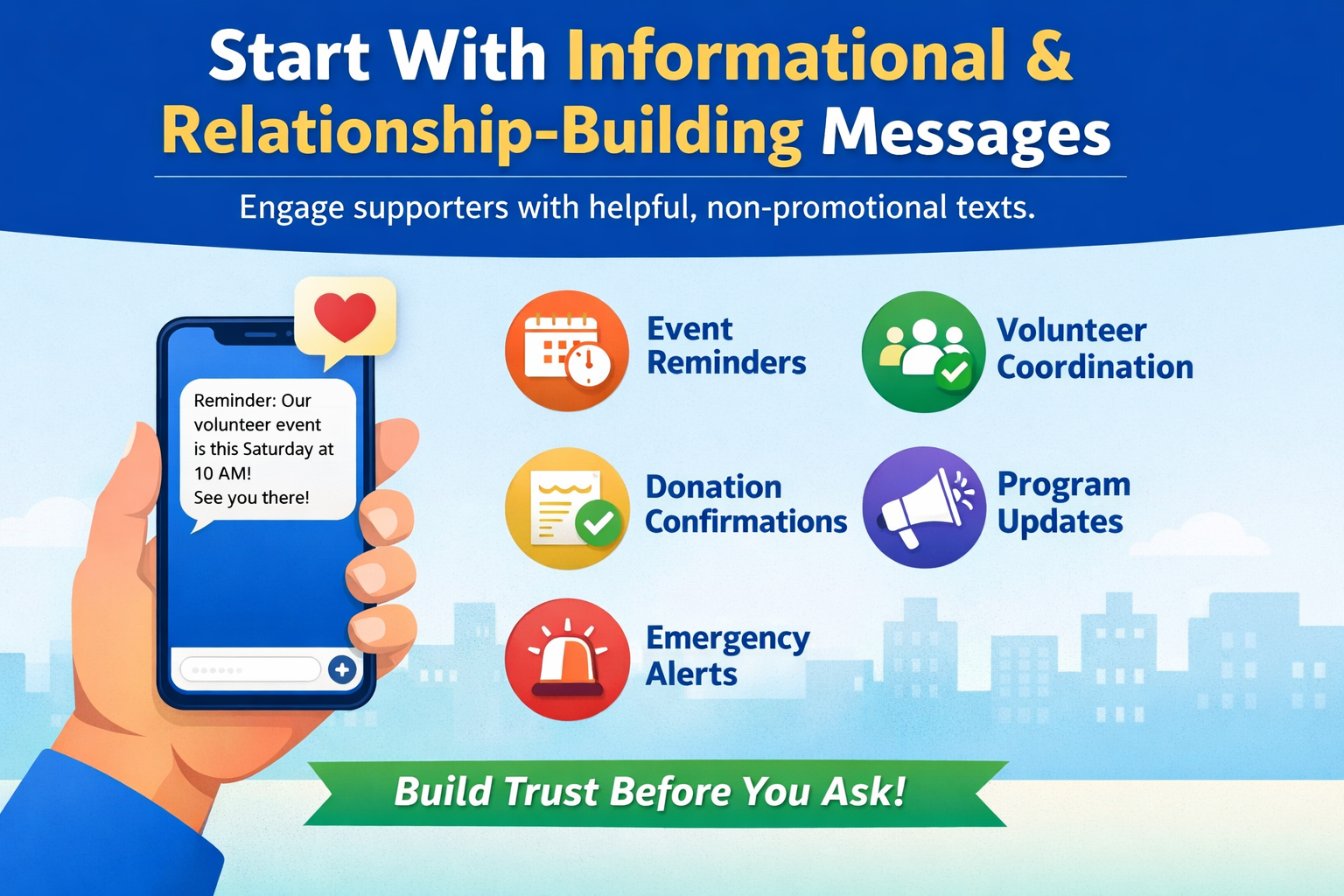
1. Start With Informational and Relationship-Building Messages
Many nonprofits begin SMS engagement with messages that are clearly informational, such as:
- Event reminders
- Volunteer coordination
- Donation confirmations
- Program updates
- Emergency notifications
Informational text messages generally carry lower TCPA risk because they are not primarily promotional. However, nonprofits must still ensure that supporters have provided their phone number voluntarily and that messages remain consistent with the original purpose of collection. Adding promotional language to an otherwise informational text message can shift it into a marketing category and trigger stricter TCPA consent requirements.
These messages establish trust, demonstrate value, and help supporters get comfortable engaging via text message. They also create a clean foundation for future fundraising outreach.
One quick note: Throughout this guide, “SMS” and “text messages” are used interchangeably.
2. Use Clear, Explicit Opt-Ins for Fundraising Text Messages
Prior express written consent is required before sending fundraising or promotional SMS using automated systems or an automatic telephone dialing system (ATDS).
Effective opt-in language clearly discloses:
- The organization’s name
- That the supporter will receive text messages
- That messages may include fundraising or promotional content
- That consent is voluntary and not a condition of purchase or donation
- How to opt out at any time
In addition to obtaining prior express written consent, nonprofits should retain detailed consent records. These records may include timestamps, opt-in language, source URLs, keyword confirmations, and message logs. Maintaining consent documentation helps nonprofits demonstrate TCPA compliance if a complaint, carrier audit, or legal challenge arises.
This approach supports TCPA compliance and improves performance. Supporters who knowingly opt in are more likely to engage, click, and donate.
3. Match the Message to the Consent
The TCPA distinguishes between transactional or informational text messages and marketing or fundraising text messages, each with different consent requirements.
One of the most common TCPA compliance issues isn’t lack of consent—it’s mismatched consent.
Successful nonprofits ensure that:
- Transactional consent is used only for transactional messages
- Fundraising texts are sent only to supporters who opted into fundraising SMS
- Advocacy or campaign texts are clearly disclosed during opt-in
Consent must be clear, documented, and aligned with the message being sent. This keeps SMS programs focused, compliant, and defensible.
4. Make Opting Out Easy (and Immediate)
Compliant nonprofit SMS programs make opting out:
- Simple (for example, “Reply STOP”)
- Respected immediately
- Logged automatically
Easy opt-outs reduce complaints, protect deliverability, and reinforce trust—even with supporters who choose to unsubscribe.
Nonprofits should also conduct regular compliance audits and train staff to ensure ongoing TCPA compliance.
The FCC allows consumers to revoke consent in any reasonable manner, including replying STOP, submitting a web form, or contacting an organization directly. Nonprofits should treat opt-out requests as immediate suppression events and ensure that internal systems prevent future messages to those numbers. Consistent opt-out handling protects deliverability and supports long-term TCPA compliance.
5. Text Less, Not More
High-performing nonprofit SMS programs do not rely on volume.
They focus on:
- Fewer messages
- Better timing, respecting quiet hours and recipient time zones
- Clear purpose
- Strong calls to action
Even when exemptions may exist for certain voice calls, nonprofit SMS programs should operate under the assumption that National Do Not Call protections apply. Combining DNC awareness with clear opt-in flows, internal suppression lists, and consent tracking creates a conservative, defensible compliance posture that aligns with modern carrier enforcement.
This approach aligns with TCPA expectations and consistently produces better fundraising outcomes than frequent, unfocused SMS blasts.
What About Nonprofit TCPA Exemptions?
Some articles suggest nonprofits are exempt from certain TCPA requirements. While limited exemptions exist—primarily related to live voice calls—they do not reliably apply to SMS text messaging.
For text campaigns, courts, regulators, and carriers increasingly focus on:
- Consent
- Message content
- Opt-out handling
Rather than relying on narrow or outdated exemptions, successful nonprofits design SMS programs that would hold up even under scrutiny. This approach is more predictable, more scalable, and safer over the long term.
What Does “Written Consent” Mean for Nonprofit Text Messaging?
When the TCPA refers to “prior express written consent,” it does not mean a supporter must sign a physical piece of paper.
In practice, written consent simply means that the supporter took a clear, documented action agreeing to receive text messages. For nonprofit SMS campaigns, this consent is almost always collected electronically.
Common examples of valid written or electronic consent include:
- Checking a consent box on an online donation or signup form
- Entering a phone number into a form that clearly discloses SMS messaging terms
- Texting a keyword to a shortcode or long code after seeing proper disclosures
- Completing a double opt-in flow that confirms intent via reply text
As long as the consent language clearly explains who is sending the messages, what type of messages will be sent (including fundraising or promotional content), that consent is voluntary, and how to opt out, electronic consent fully satisfies TCPA requirements.
What matters most is clarity and documentation, not paper. Nonprofits should be able to show how consent was collected, what language was shown, and when the supporter opted in.
Prerecorded Messages: What Nonprofits Should Know
Prerecorded messages—whether voice calls or automated text messages—are subject to additional TCPA requirements.
For any prerecorded fundraising or promotional messages, nonprofits should obtain prior express written consent and always provide clear opt-out instructions. Consent records should be stored and maintained to demonstrate compliance.
While certain non-telemarketing voice calls may qualify for narrower exceptions, prerecorded messages that include fundraising or promotional content carry higher compliance risk. Clear consent and immediate opt-out handling remain best practice.
National Do Not Call (DNC) Registry and Nonprofit SMS
The National Do Not Call Registry was created to limit unwanted telemarketing communications. While certain charitable exemptions exist for live voice calls, those exemptions do not reliably extend to SMS text messaging.
For nonprofit SMS campaigns, organizations should assume DNC protections apply unless they have clear, documented consent from the recipient. Opt-out requests must always be honored, and internal suppression lists should be maintained to prevent further contact.
Treating DNC compliance as part of a broader consent strategy helps protect supporters, reduce complaints, and strengthen long-term trust.
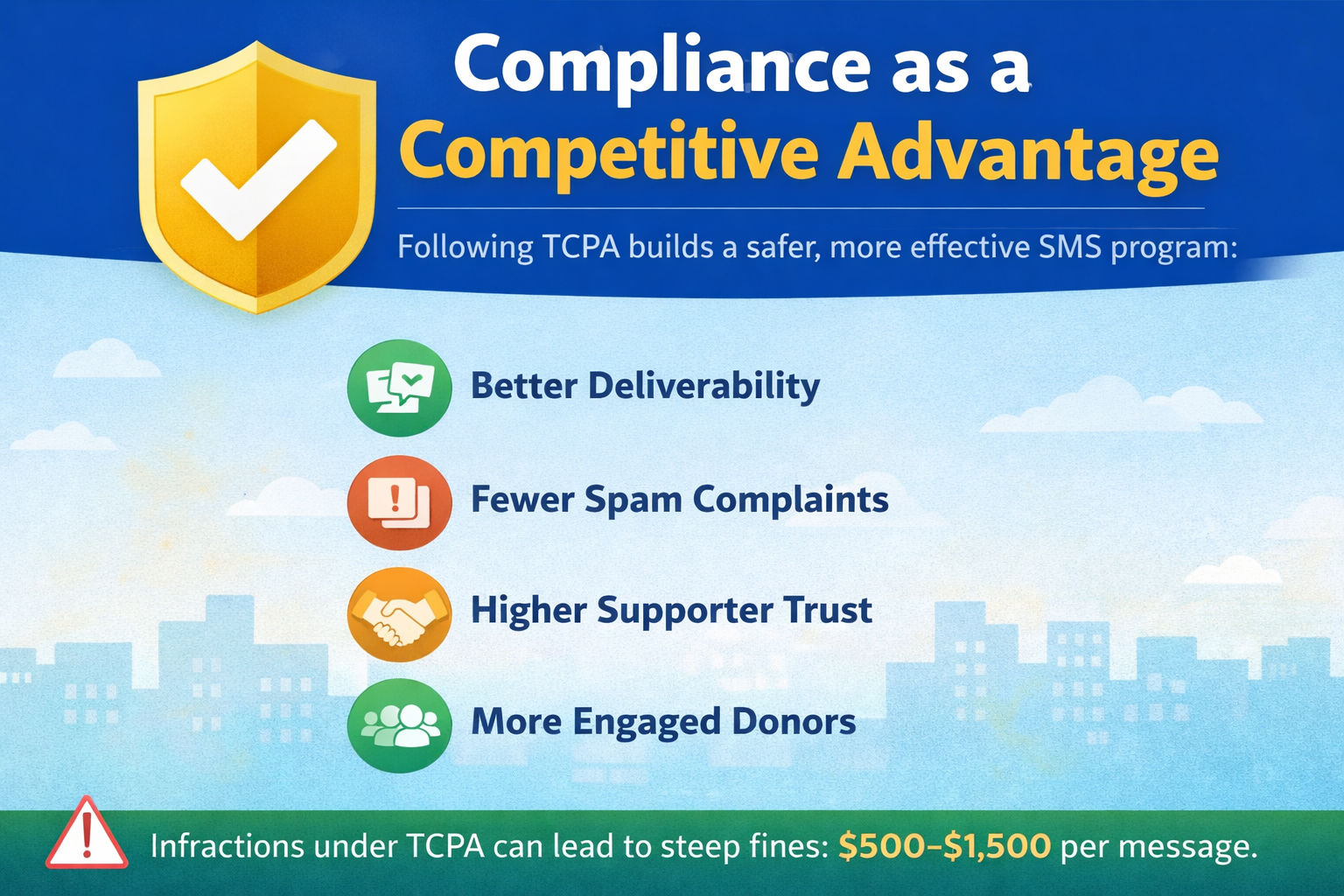
Compliance as a Competitive Advantage
When nonprofits treat TCPA compliance as part of their overall SMS strategy, it becomes a competitive advantage rather than a limitation. Permission-based text messaging leads to higher deliverability, fewer carrier filters, and stronger supporter engagement over time. By prioritizing clear consent, honoring opt-out requests, and aligning every message with what supporters agreed to receive, nonprofits reduce legal risk while improving fundraising performance. In an environment where inbox fatigue and SMS spam are increasing, compliant nonprofit SMS programs stand out by earning trust—and trust is what drives long-term donor retention.
“Compliance doesn’t slow fundraising down. It protects trust—and trust is what drives results.”
TCPA-compliant SMS programs often outperform non-compliant ones.
Why?
- Better deliverability
- Fewer spam complaints
- Higher supporter trust
- More engaged donors
- Less internal stress
- Learn about the benefits of the Rally Corp + Bloomerang Integration
While TCPA violations can carry statutory penalties of $500 per message, or up to $1,500 per willful violation, enforcement in practice typically centers on patterns of abuse, poor consent practices, and ignored opt-out requests—not well-run, permission-based nonprofit SMS programs. Proactive TCPA compliance helps nonprofits avoid unnecessary risk by creating clear consent flows, honoring supporter preferences, and maintaining accurate records. When compliance is built into everyday messaging operations, it becomes less about avoiding penalties and more about protecting trust, deliverability, and long-term supporter relationships.
Compliance isn’t a brake on growth. It is a stabilizer that allows nonprofit SMS programs to scale sustainably.
You Don’t Need to Be a Lawyer—You Need a System
Nonprofits that succeed with SMS don’t obsess over legal loopholes. They build systems that ensure:
- Clear opt-ins
- Clean contact lists
- Message-to-consent alignment
- Easy opt-outs
- Ongoing review and staff training
With the right platform and processes, SMS becomes one of the most reliable channels in a nonprofit’s fundraising and engagement strategy.
Final Thought
SMS can absolutely work for nonprofits—and it can work without breaking TCPA rules.
“Fundraising has never been about the channel. It’s about trust, clarity, and treating people like people.”
Fundraising—no matter the channel, platform, or messaging strategy—has always been about building trust. Clear communication, permission-based engagement, and a human-centered approach are foundational to effective nonprofit fundraising. TCPA compliance supports this by encouraging transparency and respect for supporters. Nonprofits that prioritize compliant SMS practices often see stronger engagement, higher donor trust, and more sustainable fundraising outcomes.
The organizations seeing the best results aren’t the ones pushing boundaries. They’re the ones earning permission, respecting supporters, and treating SMS as a relationship channel, not a shortcut.
Friendly Disclaimer
We are not lawyers, and this content is for educational purposes only. It does not constitute legal advice. TCPA requirements can vary based on facts, message content, technology used, and state law. Consult qualified legal counsel to evaluate your specific SMS program.
Frequently Asked Questions About TCPA Compliance for Nonprofits
If you’ve been researching TCPA compliance for nonprofit text messaging, you’ve probably noticed the same questions coming up again and again. These are the most common questions we hear from nonprofit leaders, fundraisers, and marketing teams who want to use SMS effectively without risking TCPA violations.
The answers below address the exact concerns organizations raise when evaluating consent requirements, opt-out rules, exemptions, and fundraising texts—and they reflect how TCPA rules are enforced in practice.
Does the TCPA apply to nonprofit text messaging?
Yes. Under the Telephone Consumer Protection Act (TCPA), SMS text messages are treated similarly to telemarketing calls, and the law applies to nonprofit organizations as well as for-profit businesses.
Do nonprofits need consent to send fundraising text messages?
Yes. Under the TCPA, nonprofits must obtain prior express written consent before sending fundraising or promotional SMS messages using automated texting systems or platforms.
Can nonprofits send informational text messages without written consent?
Sometimes. Informational or transactional text messages may rely on implied consent when a supporter voluntarily provides their phone number, but those messages must remain non-promotional and consistent with the original purpose of collection.
Are nonprofits exempt from TCPA rules?
No. While nonprofits have limited exemptions for certain live voice calls, those exemptions do not reliably apply to SMS text messaging under TCPA enforcement.
Does written consent mean supporters have to sign a paper form?
No. Written consent under the TCPA can be collected electronically. Online forms, keyword opt-ins, and double opt-in text flows all qualify as written consent when proper disclosures are provided and recorded.
Do nonprofits have to follow National Do Not Call Registry rules for SMS?
Yes. For SMS text campaigns, nonprofits should assume National Do Not Call protections apply unless they have clear, documented consent from the recipient.
What opt-out requirements apply to nonprofit SMS campaigns?
Nonprofits must provide clear opt-out instructions, such as “Reply STOP,” and must honor opt-out requests immediately. The FCC allows consumers to revoke consent in any reasonable manner.
Do prerecorded messages require consent for nonprofits?
Yes. Prerecorded voice calls or automated text messages used for fundraising or promotional purposes generally require prior express written consent under TCPA rules.
What are the penalties for TCPA violations involving text messages?
TCPA violations can result in statutory penalties of $500 per message, or up to $1,500 per willful violation, which is why proactive consent and opt-out compliance matters.
What is the safest approach to nonprofit SMS compliance?
The safest approach is permission-based SMS messaging: obtain clear consent, match messages to that consent, honor opt-outs immediately, and maintain accurate records.